


Every April 23rd, Barcelona becomes something entirely different. The city doesn’t just celebrate Sant Jordi — it transforms. Streets fill with books and roses, balconies display flags, and there is a shared sense of joy that is difficult to find anywhere else in Europe.
If you’d like to understand the origins of this tradition, we’ve covered it in detail here:
→ Sant Jordi: Barcelona’s Most Romantic and Cultural Day
But if you’re planning to be in the city this year, what really matters is understanding how Sant Jordi 2026 is structured, where to go, and how to experience it without feeling overwhelmed.
A Different Sant Jordi: What Changes in 2026
This year, Sant Jordi is shaped by an important change in the city.
Due to ongoing works on La Rambla, the traditional central axis disappears, and the celebration spreads more organically across Barcelona. The main flow now moves through areas such as Portal de l’Àngel, Plaça de Catalunya, and the surroundings of the Cathedral, while the Eixample district consolidates itself as the true backbone of the event.
This redistribution actually improves the experience. Instead of one overcrowded boulevard, Sant Jordi unfolds across multiple walkable areas, each with its own rhythm and atmosphere.
The Sant Jordi 2026 Poster: A Contemporary Symbol of the Celebration
Beyond the streets and the atmosphere, Sant Jordi also finds expression through visual culture. Each year, the city commissions an official poster that captures the spirit of the celebration, and in 2026, urban artist TVBoy offers a contemporary interpretation—blending love, literature, and the iconic symbolism of the day into a bold, unmistakably urban aesthetic.
What makes this year particularly special is that the poster is not only displayed across Barcelona, but also made accessible to everyone. It can be collected at selected locations throughout the city and is also available as a free downloadable PDF, allowing both visitors and locals to keep a lasting piece of Sant Jordi.
The full official collection can be accessed through the Ajuntament de Barcelona, where the posters are shared as part of the city’s open cultural initiatives: > https://ajuntament.barcelona.cat/cartells/en/2026/sant-jordi-2026
This small detail reflects something essential about Sant Jordi: it is not just an event you attend, but a cultural moment that the city openly shares.
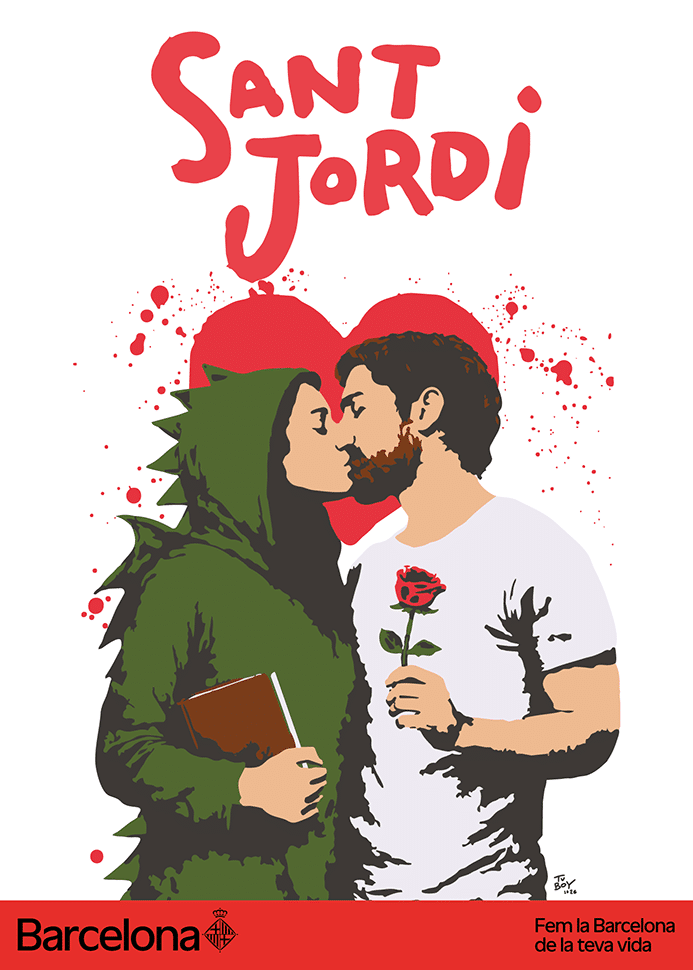
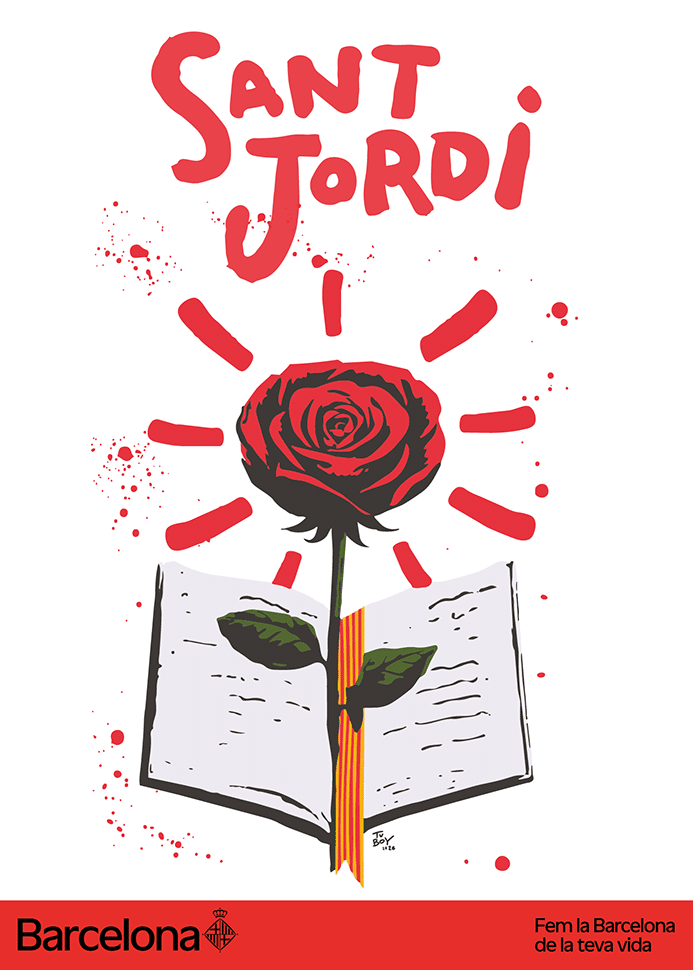
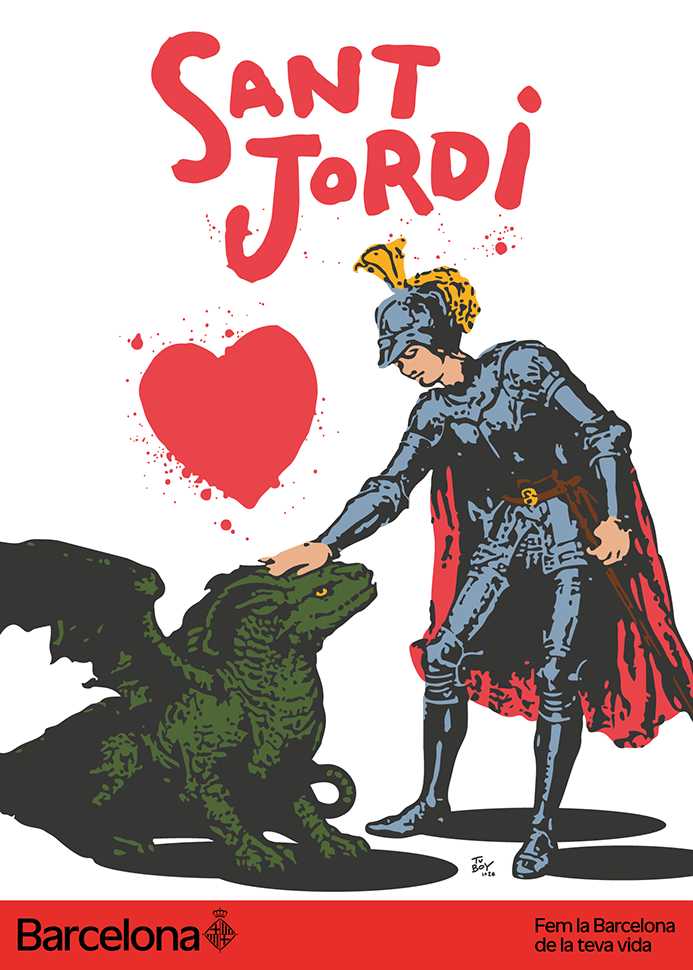
If you wish, you can download them directly here and keep a piece of Sant Jordi with you.
* Licence: Consult the terms and conditions of use *
How the City Organizes Sant Jordi
To really enjoy the day, it helps to understand how it is structured.
In 2026, Barcelona will host around 425 stalls dedicated to books and roses, with a clear predominance of literary stands. These are not concentrated in a single street, but distributed across key districts, especially Eixample and Ciutat Vella.
What makes Sant Jordi unique is that each area has developed its own identity. Passeig de Gràcia offers a more elegant and curated experience, with major publishers and carefully designed stands. Passeig de Sant Joan, by contrast, feels more local and relaxed, with independent bookstores, comics, and children’s literature. Around Arc de Triomf and Passeig de Lluís Companys, the atmosphere becomes more open and spacious, ideal for walking without constant توقف.
This diversity allows you to shape your day depending on what you’re looking for — something most visitors underestimate.
What the Day Actually Feels Like
Beyond maps and logistics, Sant Jordi is defined by its atmosphere.
From early morning, the city fills with people carrying roses, browsing books, and moving slowly through the streets. There is a sense of celebration that feels genuine rather than staged — couples exchanging flowers, friends meeting around book stalls, authors signing copies just a few steps away.
It’s a colorful, vibrant and optimistic day, where culture becomes something shared in the open air.
But there is also an important reality that shouldn’t be overlooked: the crowds are intense.
This is one of the busiest days of the year in Barcelona, and the main literary areas — especially in central locations — can become extremely dense. For many locals, this is part of the charm. For some visitors, however, it can feel overwhelming.
Understanding this in advance is key to enjoying the experience rather than struggling with it.
Beyond Books: Music, Culture and the City in Motion
Sant Jordi is often described as a literary festival, but in reality it goes much further.
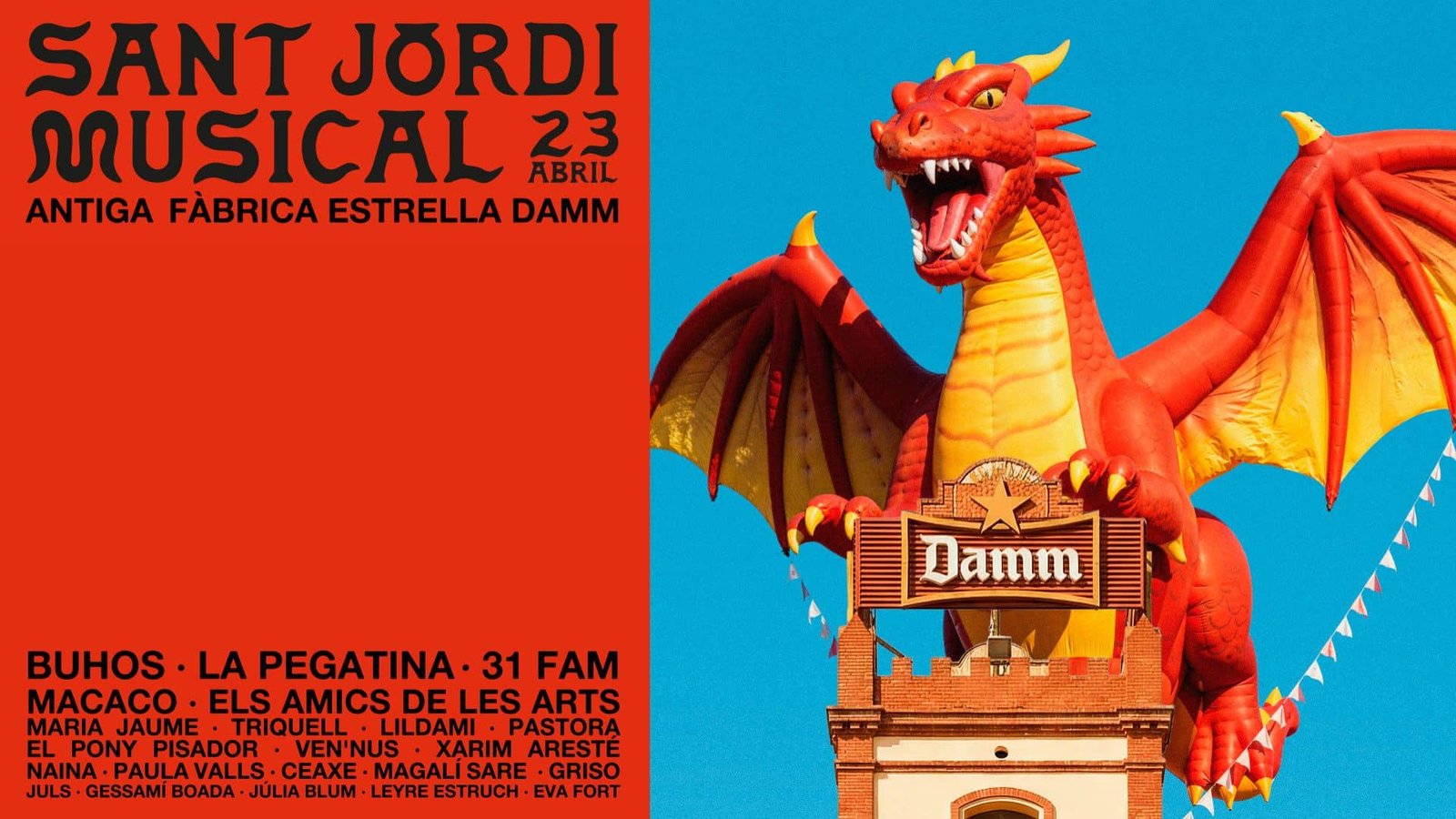
Throughout the day, Barcelona hosts a wide range of cultural activities that extend far beyond book stalls. One of the most notable examples is the Sant Jordi Musical event, held at the Antiga Fàbrica Estrella Damm. This former industrial space becomes a lively cultural hub, offering free concerts by well-known artists such as Macaco or La Pegatina, among others. It introduces a completely different energy to the day, blending literature with live music and a younger, more festive crowd.
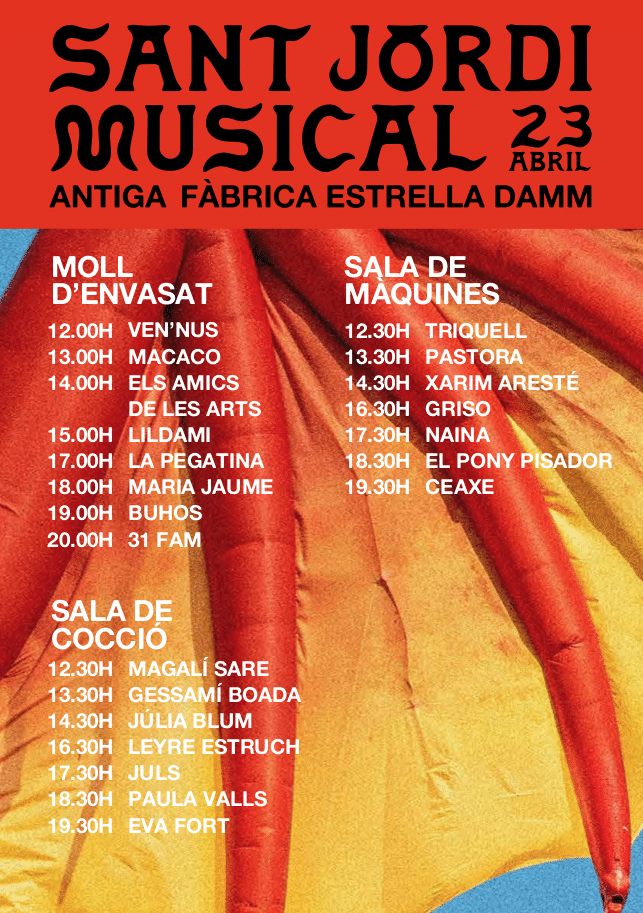
If you would like to plan your visit in detail, the full official program of Sant Jordi Musical 2026 can be downloaded here:
>> Download full program (PDF)
At the same time, areas like Plaça de Catalunya host live programming, media broadcasts, and small performances that reinforce its role as one of the central meeting points of Sant Jordi 2026.
A Rare Opportunity: Open Doors Across the City
One of the most valuable — and often overlooked — aspects of Sant Jordi is the number of historic buildings that open their doors to the public.
Institutions such as the City Hall, the Palau de la Generalitat, or the Diputació de Barcelona (notably at Casa Serra, typically open from morning until evening) allow visitors to access interiors that are normally closed or restricted.
These visits offer a completely different perspective on the city, away from the streets and the crowds, and add a layer of cultural depth that many visitors miss.
For those seeking a more refined atmosphere, places like the Ateneu Barcelonès provide a quieter alternative, with literary events, author talks, and a more intimate connection to Barcelona’s intellectual life.
Sant Jordi at the Sagrada Familia
Even Barcelona’s most iconic landmark becomes part of the celebration.
Each year, the Sagrada Familia marks Sant Jordi with special initiatives that connect tradition and architecture. These include free access for visitors named Jordi or Jordina (with a companion), as well as a limited draw offering guided visits the day before, on April 22.
These experiences are limited and require advance booking, but they offer a completely different way to engage with Sant Jordi — one that feels more symbolic and less crowded.
If you’d like to explore this in depth, we’ve covered it in a dedicated article.
How to Experience Sant Jordi Without Feeling Overwhelmed
The difference between enjoying Sant Jordi and feeling exhausted often comes down to a few simple decisions.
Starting early in the morning allows you to experience the city at a calmer pace, before peak crowds build up. Moving between different areas instead of staying in one place also helps, as each neighborhood offers a different atmosphere. And perhaps most importantly, knowing when to step away — even briefly — can completely transform your perception of the day.
For visitors who are sensitive to crowds, it’s advisable to avoid the main concentrations of book and rose stalls during peak hours and instead explore the edges of the event, where the atmosphere remains vibrant but more manageable.
FAQS
When is Sant Jordi celebrated?
Sant Jordi takes place every year on April 23rd. In 2026, it falls on a weekday, which means the city will be especially active with locals celebrating throughout the day.
Where are the main Sant Jordi areas in 2026?
Due to the ongoing works on La Rambla, the main areas shift to places like Portal de l’Àngel, Plaça de Catalunya, the Cathedral surroundings, and the Eixample district, which hosts the largest concentration of book and rose stalls.
How many book and rose stalls are there?
In 2026, Barcelona hosts around 425 stalls, most of them dedicated to books, with a smaller but essential presence of rose stands spread across the city.
What time does Sant Jordi start and end?
Sant Jordi is not a timed event, but most activity begins in the morning (around 9–10 AM), reaches its peak between midday and late afternoon, and gradually winds down in the evening. Many open-door buildings typically operate between morning and early evening hours.
Is Sant Jordi very crowded?
Yes — extremely. It is one of the busiest days of the year in Barcelona. Central areas can become very dense, especially around midday. If you prefer a quieter experience, it’s best to explore early in the morning or move towards less central areas.
Are there free activities during Sant Jordi?
Yes. Many cultural institutions and historic buildings open their doors for free, and there are also concerts, public events, and live cultural programming throughout the city.
What happens at the Sagrada Familia on Sant Jordi?
The Sagrada Familia celebrates Sant Jordi with special initiatives, including free entry for visitors named Jordi or Jordina (with a companion) and a limited draw offering guided visits the day before. Advance booking is required.
Is Sant Jordi worth experiencing as a visitor?
Absolutely — but with the right expectations. Sant Jordi is not a quiet or controlled event; it is a vibrant, crowded, and deeply local celebration. For many visitors, it becomes one of the most memorable experiences in Barcelona.
When Barcelona Becomes Sant Jordi
Sant Jordi is not a festival you simply attend — it’s something you become part of.
For a few hours, Barcelona feels more open, more human, and more connected to its own culture. Books and roses are only the surface; what truly defines the day is the atmosphere that brings the entire city together.
And once you’ve experienced it, it tends to stay with you.